
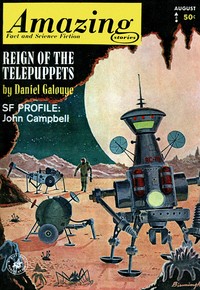
Reign of the telepuppets — Reading Notes
Edition facts
The catalog record for Reign of the telepuppets — Reading Notes provides practical reading context through 24,461 words, 1 hr 47 min estimated reading time, and 3 detected text sections.
The text analysis averages about 14.0 words per sentence, while the detected sections provide another way to judge how the source is divided.
Project Gutenberg metadata also associates the work with “Science fiction,” connecting these edition facts with the source record’s subject description.
Read the complete public-domain text at its original source.
Read on Project GutenbergThe story opens not with robots or alien contact but with a bureaucratic briefing at the Bureau of Interstellar Exploration. Director Gabe Randall, described as standing "cranelike" and whacking his thigh with an "illuminated indicator rod," sets a tone of mundane authority. The human team includes a radio empathy specialist, Carol Cummings, whose absence is noted with a hint of gender dynamics: Randall remarks that "direct radio empathy can be developed only in women—and young ones at that." This early focus on institutional procedure and character friction suggests the novella's interest in human (and alien) politics over hardware.
Two Species, One Pattern of Distrust
The excerpts alternate between human and alien perspectives, yet both camps exhibit similar internal discord. Among the humans, Stewart doubts the competence of his colleagues: pilot McAllister is described as having a "general absence of ambition," and systems officer Mortimer is noted for "the sheer weight of his two hundred and fifty pounds." On the Tzarean side, Chancellor Vrausot bullies his pilot Kavula and dismisses the cautious Mittich. The Tzarean dialogue is laced with aquatic metaphors—"floundering minnow," "drown peaceful contact"—that reinforce their non-human origin while mirroring human stubbornness. The catalog subject "human-alien encounters" is thus complicated by the fact that the aliens are encountered primarily through their own internal power struggles, not through direct interaction with humans.
The Telepuppets as Absent Center
Despite the title, the telepuppets themselves appear only obliquely in the excerpts. Stewart has a nightmare "brought on by his previous day's experience with the telepuppets," but the nature of that experience is not detailed. The catalog subject "robots" is therefore more a promise than a presence in the sampled text. What the excerpts do show is a preoccupation with control and perception: Randall uses a "ten-foot sphere of galactic luminosity" to brief his team, while Vrausot manipulates a teleview screen to designate targets. The technology is present, but the titular entities remain offstage, functioning as a looming unknown rather than an active force. Readers should expect the telepuppets to gain significance later, but the early chapters emphasize the political and psychological landscape instead.
Voice and Structure: Alternating Tensions
The narrative voice shifts between a wry, observational tone in human scenes and a more agitated, exclamatory style in Tzarean passages. Randall speaks with "imperceptible jocularity," while Vrausot "hissed" and "fumed." The Tzarean sections are punctuated by physical actions—"great tails thumping down on the deck"—that ground the aliens in a different biology. Structurally, the excerpts show a pattern of escalation: Randall's briefing is calm, but Vrausot's scene builds to a threat of genocide. The human team is still assembling, while the aliens are already preparing to strike. This asymmetry creates a dramatic irony: the reader knows more about the alien threat than the human characters do. The catalog subject "interstellar travel" is thus less about the journey than about the collision course between two civilizations that have not yet met.
Readers should note that the excerpts end before any direct human-alien contact occurs. The story's title and catalog subjects suggest a focus on robots and alien encounters, but the early chapters invest heavily in bureaucratic and psychological conflict. Pay attention to how the telepuppets are eventually introduced and whether they serve as a bridge or a barrier between the two species. The alternating viewpoints may converge later, but the evidence so far points to a narrative driven by miscommunication and internal dissent rather than action.
That rainy afternoon, I kept returning to the telepuppets’ quiet menace, how easily trust dissolves. Later, restless, I picked up stray notes and found myself drifting toward Highways in Hiding — Key Ideas to Explore, a book about suspicion on the road. Same unease, different map. I watched the rain streak the window and thought how stories echo each other without ever meeting.
There are no reviews for this eBook.
Your personal reading reflection
Build a private reading journal entry for this title.