
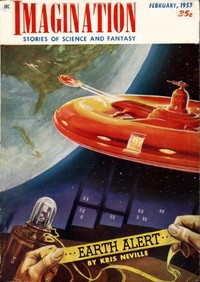
Earth Alert! — Background and Themes
Edition facts
This digital edition of Earth Alert! — Background and Themes is described by source-level measurements including 37,039 words, 2 hr 42 min estimated reading time, and 4 detected text sections.
The text analysis averages about 9.2 words per sentence, while the detected sections provide another way to judge how the source is divided.
Project Gutenberg metadata also associates the work with “Science fiction,” connecting these edition facts with the source record’s subject description.
Read the complete public-domain text at its original source.
Read on Project GutenbergThe story opens with a precise financial detail: Julia inherits $20,247.50 after taxes, a sum that feels both specific and oddly mundane for a science fiction tale. This grounding in everyday life—a bookshop job, a conservative brown suit, a father puzzled by the money—contrasts sharply with the extraterrestrial threat that soon emerges. Neville builds the narrative through alternating scenes: Julia's determined search for a husband in Hollywood and, out beyond the moon, a wheel-shaped space station where aliens discuss their invasion plans. The structure relies on this back-and-forth, moving from the concrete to the cosmic without warning.
Money, Marriage, and Mundane Motives
Julia's inheritance is not a springboard for adventure but a tool for a practical goal: buying a husband. She thinks, "I'm going to buy me a husband: I've always wanted one," a line that reveals her direct, unsentimental approach. The narrative lingers on her careful shopping—a brown suit, a transfer of funds to Los Angeles—and her father's bemused comment, "God help the man you set your mind on." These details establish a character who is both calculating and naive, grounded in the ordinary even as she steps toward the extraordinary. The money itself becomes a recurring motif, a tangible link between her human world and the alien one that will soon disrupt it.
Invisible Aliens and Distortion Fields
The aliens are introduced through their technology: a "distortion field" that can render them invisible and a space station that spins to simulate gravity. When the field fails, the Mt. Palomar telescope briefly tracks the station, but astronomers dismiss it as a photographic irregularity. This detail underscores the aliens' stealth and Earth's obliviousness. Later, Julia uses a distortion field to hide the unconscious alien Walt, dragging his invisible body through a hotel lobby. The clerk's suspicion and the elevator operator's warnings about bars and rape create a comic tension between the mundane and the bizarre. The field is a physical presence—Julia feels "as conspicuous as if she were smoking a pipe"—and a narrative device that makes the invisible visible through its effects.
Movement Between Earth and Space
Neville structures the story by cutting between Julia's ground-level perspective and the aliens' orbital conference. In the space station, the aliens communicate telepathically, their thoughts marked by bold type: "There can't be any doubt but that she's dead," Forential projects. The Elder plans to strike on a Sunday morning when the American Air Force is least alert. These scenes are brief but pivotal, providing the cosmic stakes that Julia is unaware of. The movement is abrupt—from a hotel room to a wheel-shaped station—and the contrast in scale is deliberate. Julia's struggles with Walt's dead weight and the aliens' cold calculations create a rhythm of intimacy and distance, personal and planetary.
Superstition and Unease
After tying Walt to the bed, Julia whistles and then stops, recalling the adage: "A whistling girl and a crowing hen are sure to come to some bad end." This moment of superstition colors her with unease, and she reflects that "there might be a million such superstitions—many of them not recognized as superstitions." The detail is small but telling: it hints at a world where irrational fears coexist with alien technology. Julia's practical actions—ripping sheets into strips, using a knot that requires cutting—are undercut by this sudden awareness of folk wisdom. The narrative does not resolve this tension, leaving the reader to wonder whether her unease is justified or merely a remnant of the ordinary world she is leaving behind.
The excerpts offer only the opening chapters, so the full arc of Julia's encounter with the alien invasion remains unknown. What is clear is Neville's method: he builds the fantastic on a foundation of the quotidian, using money, clothing, and hotel clerks to make the extraordinary feel tangible. Readers should attend to the way small, concrete details—a bank transfer, a torn sheet, a whistled tune—carry the weight of the story's larger concerns.
I remember reading Earth Alert! years ago, feeling the strangeness of Julia’s quiet preparations against an invisible otherworldly hum. It reminded me of the patient loneliness in World Edge — Background and Themes, where the horizon itself feels like a held breath. Both worlds ask what waits just out of sight, and I sat with that thought for a long while.
There are no reviews for this eBook.
Before you leave, reflect on the book
Use these questions to collect your thoughts before moving on.