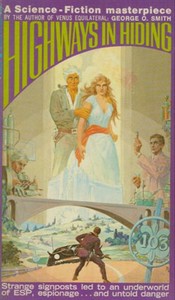
Highways in Hiding — Key Ideas to Explore
Edition facts
Before opening Highways in Hiding — Key Ideas to Explore, the edition data offers a quick orientation: 85,374 words, 6 hr 12 min estimated reading time, and 8 detected text sections.
The text analysis averages about 14.6 words per sentence, while the detected sections provide another way to judge how the source is divided.
Project Gutenberg metadata also associates the work with “Science fiction,” connecting these edition facts with the source record’s subject description.
Read the complete public-domain text at its original source.
Read on Project GutenbergGeorge O. Smith opens Highways in Hiding with a typographic innovation: a historical note explaining that the symbol # is used to denote telepathic communication, a device previously restricted to technical papers. This editorial choice immediately signals that the novel treats mind-reading as a precise, quasi-scientific phenomenon rather than a mystical power. The story itself begins in medias res with protagonist Steve Cornell holding a gun on a man named Macklin, torn between a desire for revenge and a deeper need to find Catherine. Smith’s prose is lean and hard-boiled, with Cornell describing himself as “a hundred and sixty pounds of boil” after a car accident. The early chapters establish a world where telepathic perception is a delicate sense that fails under physical trauma, and where the mysterious “Highways in Hiding” organization operates in the shadows.
Telepathy as a Typographic and Thematic Device
The novel’s most immediately visible feature is the use of # to bracket telepathic speech, as explained in the prefatory “Historical Note.” This is not merely a gimmick; it reflects a systematic approach to mental communication. In the excerpts, characters use telepathy for rapid, covert exchanges, but Smith also emphasizes its limitations: after his accident, Cornell notes that “perception was one of the first to go,” and he can only sense a few inches beyond his body. Later, a telepath character complains that knowing what will happen next “takes all the pleasant element of surprise out of their lives.” The symbol thus serves as a constant visual reminder that the story operates under rules where minds are both connected and vulnerable.
The Mekstroms: Biology and Paranoia
The catalog subject “Extrasensory perception” is paired with “Epidemics,” and the excerpts reveal a biological threat: “Mekstrom Flesh” and the concept of being a “Mekstrom Carrier.” Cornell desires a “body of Mekstrom Flesh, to be a physical superman,” but the condition is also a liability. A female character warns that Scholar Phelps would “use you for his own purpose,” and that Cornell’s ignorance of his own carrier status previously made him useful. The disease or transformation is contagious via unknown means, and carriers can be tracked or herded. Smith blends superhuman strength—a woman described as “steel hard and monster strong”—with the paranoia of a hidden epidemic, creating a world where physical enhancement and social ostracism go hand in hand.
Narrative Voice and the Unreliable Protagonist
Steve Cornell narrates in a colloquial, self-deprecating first person that recalls mid-century noir detectives. He admits he “couldn’t pull the trigger” even when he wanted to, and describes his own weapon as “about as useful to me as a stuffed bear.” His internal monologue is laced with dark humor and frustration. Yet the excerpts also show him outmaneuvered: telepaths anticipate his plans, and he is repeatedly captured or coerced. The opening scene’s stalemate—where he holds a gun but cannot act—establishes a protagonist whose agency is constantly undermined. This tension between Cornell’s tough-guy voice and his actual helplessness drives the narrative, as he struggles to understand the conspiracy he is trapped in.
Readers should pay attention to how Smith uses the # symbol not just for dialogue but for moments of internal conflict and sudden revelation. The novel’s pacing alternates between action set-pieces—like the car chase with rifle fire—and tense conversations where telepathic subtext matters as much as spoken words. The incomplete excerpts leave the full nature of the Mekstroms and the Highways organization unclear, but the groundwork is laid for a story that treats telepathy as both a tool and a curse.
I kept thinking about Steve Cornell’s lonely pursuit through the telepathic static, and how that particular paranoia lingers long after the last page. It reminded me of something quieter, an understated meditation in World Edge — Background and Themes about walking the margins of a story, where the real edge isn’t geography but trust. Both feel like old friends’ whispers.
There are no reviews for this eBook.
Record your reading impressions
A brief reflection can help important ideas stay with you longer.