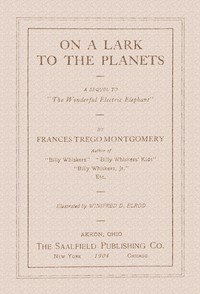
On a lark to the planets A sequel to "The wonderful electric elephant" — Story, Setting & Ideas
Edition facts
The catalog record for On a lark to the planets A sequel to "The wonderful electric elephant" — Story, Setting & Ideas provides practical reading context through 30,993 words, 2 hr 15 min estimated reading time, and 18 detected text sections.
The text analysis averages about 22.0 words per sentence, while the detected sections provide another way to judge how the source is divided.
Project Gutenberg metadata also associates the work with “Science fiction,” connecting these edition facts with the source record’s subject description.
Read the complete public-domain text at its original source.
Read on Project GutenbergFrom its opening sentence, On a lark to the planets establishes a tone of wonder and precise observation: the travelers sail through “diamond-specked space” in a balloon-borne elephant, surrounded by planets described by specific colors—Neptune “wrapped in a bluish-green vapor,” Jupiter “like a glorious, crimson jewel,” Mercury “bathed in a metallic green color.” The narrative voice blends childlike curiosity with a cataloger’s eye for detail, a pattern that persists throughout the excerpts.
The story is a sequel to The Wonderful Electric Elephant, and the excerpts show the author, Frances Trego Montgomery, balancing fantastical invention with practical problem-solving: when the balloon halts, Harold consults a “book of directions” rather than relying on magic. This tension between the marvelous and the methodical shapes the journey.
A Guide Who Is Also a Planet
The excerpts introduce Mercury not as a distant sphere but as a character—a guide who can speak and who fears his leave will expire if the travelers delay. This personification of a planet is handled with matter-of-factness: Mercury says he “feared he should not be able to accompany them longer unless they returned to the heavens immediately.” The travelers treat him as a valued companion, with Ione declaring, “no other guide would be acceptable to us after having been led by you.”
This choice collapses the distance between astronomical object and sentient being, yet the narrative never pauses to explain the transformation. The reader is simply expected to accept that a planet can take human-like form and negotiate travel itineraries. The effect is a world where the cosmic and the conversational coexist without friction.
The Prince’s Afterthought on Power
Midway through the excerpts, a political subplot emerges that is notably grounded for a space fantasy. The Prince, traveling with the party, decides not to return to Siam because his reappearance would force his brother to abdicate the throne. He says, “I care nothing for the throne so why not let them still think me dead and allow my brother to live in peace?”
This moment introduces a tension between personal desire and political consequence. The Prince initially thought only of “the pleasure it would give the Princess and myself to surprise and see them once more,” but later realizes the disruption his return would cause. The captain approves the decision, noting it would have been “too bad to shorten the aerial trip of the Princess.” The episode suggests that even in a story of interplanetary larks, the authors are attentive to the real-world implications of power and succession.
Earthly Interlude: Paris as a Known Quantity
Before the celestial journey resumes, the travelers spend a week in Paris. The narrator declines to detail the visit, stating, “those who have been in Paris can imagine and those who have not may hold it in anticipation.” This is a striking narrative choice: after pages of invented planets and magical elephants, the story treats a real city as too familiar to describe.
The Paris episode is summarized briskly—visiting theatres, Versailles, the Louvre, shopping, dining—and the travelers return “pretty well tired out.” The contrast is sharp: the unknown planets receive vivid, color-coded descriptions, while a known Earth city is handled with a shrug. This suggests the book’s primary interest lies in the invented, not the actual, and that the author trusts readers to fill in the blanks for the mundane.
Readers approaching On a lark to the planets should be prepared for a narrative that shifts between detailed astronomical color and abrupt ellipses. The excerpts show a story willing to pause for a moral dilemma about a throne, then skip an entire week in Paris with a wave. The tone is consistently light, but the logic is not always consistent: the same book that personifies Mercury also includes a “book of directions” for the balloon. This mix of whimsy and practicality is the story’s defining texture.
I remember how Harold and Ione’s balloon-elephant drift felt less like adventure than like a quiet question about leaving things behind. That same ache surfaced later in Beyond the stars — Themes and Context, where the longing isn’t for far places, but for the familiar ones we’ve already changed. Strange, how two books can share one heartbeat.
There are no reviews for this eBook.
What did you think of this book?
Answer a few questions and save a private reflection on this device.