Jimsy and the Monsters — A Closer Reading

(0 User reviews)   409
In Category - Other Worlds
Sheldon, Walter J., 1917-1996 Project Gutenberg 2010 Not confirmed
Science fiction; Short stories; Human-alien encounters -- Fiction; Motion picture industry -- Fiction; Hollywood (Los Angeles, Calif.) -- Fiction Readers of public-domain and historical texts
Project Gutenberg digital edition en

Edition facts

Words 8,697
Reading time 38 min
Text sections 1

For Jimsy and the Monsters — A Closer Reading, the stored edition analysis reports 8,697 words, 38 min estimated reading time, and 1 detected text section.

The text analysis averages about 12.3 words per sentence, while the detected sections provide another way to judge how the source is divided.

Project Gutenberg metadata also associates the work with “Science fiction,” connecting these edition facts with the source record’s subject description.

Walt Sheldon's 1950s satire pits a spoiled child star against Hollywood's attempt to manufacture terror, using clipped dialogue and prop-room monsters to skewer the film industry's creative bankruptcy.
Share

Read the complete public-domain text at its original source.

Read on Project Gutenberg

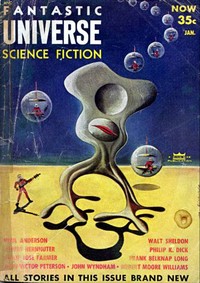
Walt Sheldon opens "Jimsy and the Monsters" with a producer named Maximilian Untz critically eyeing three prop monsters—a globelike head on spidery legs, a willowy long-clawed figure, and a hairy one—while the real horror, child star Jimsy LaRoche, plays canasta with electricians. The story's voice is established immediately: a sardonic, fast-paced narration that treats Hollywood's absurdities with deadpan precision. Sheldon's diction favors short, punchy sentences and theatrical gestures—"He took his time"—that mirror the performative nature of the film set. The dialogue, especially Jimsy's dismissive "pfui" and his address of the producer as "Max," signals a power struggle rendered in miniature, where an eleven-year-old commands the room.

Diction and the War of Words

Sheldon's word choices consistently undercut the gravity of the alien threat. The monsters are described with clinical detachment: "globelike head," "willowy and long-clawed," "covered with hair." The narrator notes the prop department "had outdone itself," a dry compliment that reduces cosmic horror to craftsmanship. Jimsy's vocabulary—"pfui," "goof-off"—contrasts with Mr. Untz's Viennese-inflected exasperation: "I would give my right eye for some really horrible monsters." The cold war between them is rendered in physical terms: "the sort you could almost hear hotting up." Sheldon avoids melodrama; even when aliens escape, the prose stays clipped: "After that it was every man for himself."

The Set as a Character

The sound stage is more than a backdrop; it functions as a pressure cooker. Sheldon populates it with script girls, cameramen, electricians, and a rifleman whose bullets have no effect. The hierarchy is clear: Mr. Untz snaps his fingers, Harold Potter relays orders, and Jimsy emerges "from behind the wall flat." The studio's physical layout—cables, cameras, the cage, the warning light and rocker arm—is described with the precision of a stage direction. When the monsters breach the cage, the chaos is mapped through movement: "Everybody scattered a second time." The setting itself, a Hollywood dream factory, becomes the source of the real nightmare.

Voice Through Dialogue and Gesture

Sheldon reveals character through what characters say and how they say it. Jimsy's first line—"Okay, so what is it now?"—establishes his bored entitlement. Mr. Untz's injured tone—"You saw it. You heard it. You see what I've got to put up with"—is both comic and pathetic. Harold Potter's internal commentary—"He admired the producer's occasional flashes of genius, he deplored his more frequent flashes of stupidity"—provides a wry counterpoint. Physical gestures amplify voice: Jimsy shrugs and walks away; Mr. Untz "whirled and shot a finger" at the boy. The aliens themselves communicate through "angry chirping" and vibrating skin, a non-verbal language that underscores the failure of human speech to control the situation.

Recurring Details and Structural Irony

Sheldon plants details that echo across scenes. The snails Jimsy carries from the shower—a gross, mundane prop—mirror the alien tentacles later described as "uncoiling." Mr. Untz's lament, "I should have stayed in Vienna," recurs as a refrain, underlining his displacement. The locked door that "nobody remembered to lock" becomes a running joke, first with the cage, then with the sound stage. The story's structure hinges on inversion: the manufactured monsters fail to scare, but the real aliens cause panic. Sheldon's irony is consistent: Hollywood, which creates horrors for a living, is helpless when actual horror arrives.

Readers should pay attention to how Sheldon uses the film set's jargon—"meld," "flat," "prop department"—to ground the fantastic in the mundane. The story's humor depends on recognizing the gap between the grandiose ambitions of the producer and the petty reality of a child star's tantrum. The aliens, when they appear, are less terrifying than the human egos they disrupt. This is not a story about monsters; it is a story about the monstrousness of Hollywood's machinery.

That rainy afternoon, I kept circling back to how Sheldon’s monsters were just props—hollow, waiting for someone to believe in them. The satire left a strange ache, and I found myself reaching for Earth Alert! — Background and Themes almost without deciding to, as if the same quiet dread had followed me there, only softer, less mocking. Some afternoons choose their own next book.

There are no reviews for this eBook.

0
0 out of 5 (0 User reviews )

Add a Review

Your Rating *
There are no comments for this eBook.

Reader reflection

What did you think of this book?

Answer a few questions and save a private reflection on this device.

Your progress 0 / 10
1

How far have you progressed with this book?

2

What was your overall reaction to the book?

3

Would you recommend this book to another reader?

4

How much effort did this book require?

Related eBooks