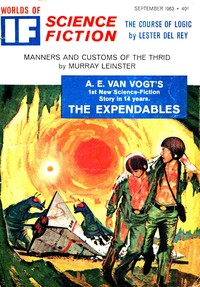
The expendables — Text and Context
Edition facts
This digital edition of The expendables — Text and Context is described by source-level measurements including 14,575 words, 1 hr 4 min estimated reading time, and 2 detected text sections.
The text analysis averages about 14.9 words per sentence, while the detected sections provide another way to judge how the source is divided.
Project Gutenberg metadata also associates the work with “Science fiction,” connecting these edition facts with the source record’s subject description.
Read the complete public-domain text at its original source.
Read on Project GutenbergThe story opens with a blunt declaration: the spaceship Hope of Man has been in orbit around Alta III for one hundred and nine years after leaving Earth. Captain Browne announces that a lifeboat will be dropped to the planet, and that every crew member must consider himself expendable. The language is stark, almost bureaucratic, but the situation is immediately tense: John Lesbee, the fifth of his line, recognizes that the captain is using the mission to exile his political enemies—including Lesbee and seven co-conspirators. The excerpt reveals a ship rife with factionalism, where the rhetoric of courage and sacrifice masks a power struggle.
The Smell of the Ship and the Weight of Generations
Van Vogt grounds the reader in sensory detail early on. When Lesbee retreats to his room, it is the smell of the ship that soothes him: “the odor of energy and the scent of metal under stress” are perpetual companions. This olfactory cue recurs later, when after the acceleration crisis the ship smells “different: better, cleaner, purer.” The change signals a fundamental shift in the ship’s state—a physical transformation that mirrors the plot’s pivot from human conflict to cosmic discovery. The author also emphasizes generational weight: Lesbee is the fifth of his line, and the colonists are fourth and fifth generation. The voyage is not an adventure but a inherited burden, and the captain’s speech invokes “our great grandparents, our forefathers” as a moral lever.
Acceleration as Revelation
The middle excerpt is dominated by a harrowing sequence of accelerations. Van Vogt renders the physical experience in precise, clinical terms: “Acceleration Three caught Browne. Like a rock propelled by a catapult he shot toward the rear wall.” The G-forces are numbered and described as having a “momentary resilience” before pinning victims. Lesbee, pinned to his chair, feels “his eyes felt glassy; his body had long since lost all feeling.” This bodily dissolution is a prelude to a conceptual breakthrough: the accelerations, programmed by the Karn robot Dzing, achieve a “shift to a new state of matter in motion”—the “light speed effect.” The revelation that the ship had always possessed this potential, and that earlier experiments missed it, reframes the entire century-long journey as a tragic oversight.
The Karn and the Silent Telepathy
Throughout the crisis, Lesbee interacts with an alien presence called the Karn. The excerpts show the Karn as a telepathic entity whose thoughts become inaccessible: “if Dzing was telepathing to his masters, it was no longer on the human thought level.” The robot’s motives remain opaque. Earlier, Lesbee activates a remote control for the landing mechanism, hoping to “turn on his thoughts,” but the ether stays silent. This ambiguity is central to the story’s tension—the Karn is not a villain with clear goals but a catalyst for transformation. The reader, like Lesbee, must infer its intentions from actions alone. The narrative withholds the Karn’s perspective, keeping the alien truly alien.
A Ship of Hidden Potentials
The excerpts repeatedly emphasize that the Hope of Man is not what it seems. The acceleration series reveals a velocity “a solid fraction of the speed of light” achieved in hours, a capability the ship’s designers never exploited. Lesbee reflects that “during all this slow century of flight through space, the Hope of Man had had the potential for this vastly greater velocity.” This theme of latent power extends to the human characters: Lesbee, initially a conspirator, becomes the ship’s unlikely savior. The story’s structure—opening with a political setup, then veering into a survival crisis—mirrors this revelation. The first-time reader should note how Van Vogt withholds key information about the ship’s technology and the Karn’s nature, parceling it out through physical ordeal rather than exposition.
Van Vogt’s novella rewards attention to its sensory and structural details. The shift from interpersonal conflict to a physics-defying crisis is abrupt but deliberate, mirroring the ship’s own hidden potential. Readers should note how the author uses physical sensation—smell, pressure, numbness—to convey abstract ideas about time, matter, and alien consciousness. The ending, not included here, likely resolves the tension between human politics and cosmic forces, but the excerpts suggest that the true conflict is not between Lesbee and Browne, but between humanity’s limited understanding and the universe’s hidden laws.
I keep thinking about how the Hope of Man feels like a pressure vessel in Van Vogt’s hands—every choice tightening the hull. The G-force scenes stay with me long after. There’s a different kind of waiting, quieter, in Key Out of Time — Background and Themes, where time itself breathes. I remember finding both in the same worn paperback stack, and how each made the other feel more true.
There are no reviews for this eBook.
How will you remember this book?
Save your reaction, strongest insight, and memorable passage.