A princess of Mars — Background and Themes

(0 User reviews)   402
In Category - Space Future
Burroughs, Edgar Rice, 1875-1950 Project Gutenberg 1993 Not confirmed
Science fiction; Mars (Planet) -- Fiction; Princesses -- Fiction; Carter, John (Fictitious character) -- Fiction; Dejah Thoris (Fictitious character) -- Fiction Readers of public-domain and historical texts
Project Gutenberg digital edition en

Edition facts

Words 70,989
Reading time 309 min
Text sections 32

A princess of Mars — Background and Themes can be approached with a clearer sense of reading commitment from its source measurements: 70,989 words, 5 hr 9 min estimated reading time, and 32 detected text sections.

The text analysis averages about 28.6 words per sentence, while the detected sections provide another way to judge how the source is divided.

Project Gutenberg metadata also associates the work with “Science fiction,” connecting these edition facts with the source record’s subject description.

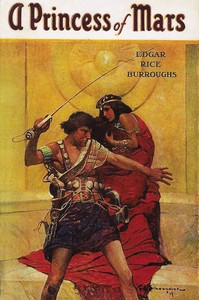
Edgar Rice Burroughs' 1912 novel introduces John Carter, a Confederate veteran transported to Mars, where he navigates alien cultures, battles green Tharks, and rescues the princess Dejah Thoris. The narrative shifts between Carter's first-person adventure and Sola's tragic backstory, revealing layered pacing and voice.
Share

Read the complete public-domain text at its original source.

Read on Project Gutenberg

The narrative of A Princess of Mars opens with a frame story: a foreword by an unnamed editor who recalls Captain John Carter as a tall, laughing Virginian, a "splendid specimen of manhood" with steel-gray eyes. This measured, almost biographical tone contrasts sharply with the breakneck action that follows once Carter is transported to Mars. Burroughs uses the first-person voice to create immediacy in battle scenes—"With my back against a golden throne, I fought once again for Dejah Thoris"—while the pacing slows considerably during Sola's harrowing account of her mother's torture and death. The novel thus alternates between breathless combat and reflective, almost Gothic storytelling, a structural rhythm that rewards attention to shifts in tempo.

Voice and the Frame Narrator

The foreword establishes a narrator who knew Carter personally, describing him with the affectionate distance of memory. Phrases such as "he seemed always to be laughing" and "his courtliness was that of a typical southern gentleman" ground the fantastic tale in a recognizable, almost nostalgic American past. This voice returns only briefly at the end, creating a bookend that reminds the reader the story is being told after the fact. The effect is a layering of perspectives: the editor's calm, retrospective tone versus Carter's urgent, present-tense adventures. Pay attention to how the editor's voice colors the credibility of Carter's claims—he presents the manuscript without judgment, letting the reader decide.

Pacing and the Shift to Sola's Story

Chapters XV through XVII mark a pronounced change in pace. After a series of duels, escapes, and chases, the narrative slows as Sola recounts her mother's imprisonment and death. Her speech is measured, filled with detail: "the lesser moon swung clear of the overhanging roofs," "she slipped stealthily in upon the trailing tailboard." The emotional weight of this section—torture, betrayal, a mother's sacrifice—contrasts with Carter's earlier physical exploits. Burroughs uses Sola's story to deepen the world-building and to introduce a tragic backstory that reframes the Thark culture. The pacing here is deliberate, almost novelistic, and rewards readers who attend to the shift from action to interiority.

Recurring Details and Structural Echoes

Burroughs repeats certain motifs across the excerpts: the "golden throne" appears in both the illustrations list and a battle scene; the act of drawing a map on marble floor recurs as a key moment of knowledge transfer. These details create a sense of cohesion across the episodic structure. The setting also echoes: the Arizona cave that opens the story is mirrored by the "At the Arizona Cave" chapter closing the book, suggesting a circular journey. Similarly, the phrase "the only pass through the hills" in Sola's story echoes the geography of Carter's early escape. These structural echoes reward a careful reader who notes how the landscape of Mars mirrors the American Southwest.

Readers may find it useful to track the shifts in narrative speed: the breathless action of Carter's first-person account versus the slower, more reflective passages told by or about other characters. The novel's structure rewards attention to these changes, as they often signal a shift from external conflict to internal revelation. Consider how the frame narrator's voice frames the entire tale, and how the recurring motifs of maps, thrones, and caves tie the Martian adventure to Carter's earthly origins.

The rain blurred my window that afternoon, and Burroughs’ Mars felt oddly close, its red dust mixing with the grey light. Sola’s quiet grief stayed with me longest, more than the swordplay. Later, wandering the shelf, I pulled down Pioneers of spacePioneers of space — Background and Themes. It shared that same ragged loneliness, that ache of leaving a world behind. I read until the rain stopped.

There are no reviews for this eBook.

0
0 out of 5 (0 User reviews )

Add a Review

Your Rating *
There are no comments for this eBook.

Reader reflection

What was your reading experience?

Capture what you thought, learned, and would like to remember.

Your progress 0 / 10
1

Where are you in your reading?

2

How much did you enjoy the reading experience?

3

Would you pass this book on to a friend?

4

Did the language feel accessible?

Related eBooks