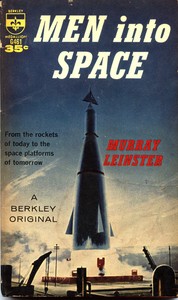
Men into space — Text and Context

(0 User reviews)   117
In Category - Space Future
Leinster, Murray, 1896-1975 Project Gutenberg 2022 Not confirmed
Science fiction; Astronauts -- Fiction; Outer space -- Exploration -- Fiction; Space travelers -- Fiction Readers of public-domain and historical texts
Project Gutenberg digital edition en

Edition facts

Words 54,309
Reading time 237 min
Text sections 6

For Men into space — Text and Context, the stored edition analysis reports 54,309 words, 3 hr 57 min estimated reading time, and 6 detected text sections.

The text analysis averages about 12.9 words per sentence, while the detected sections provide another way to judge how the source is divided.

Project Gutenberg metadata also associates the work with “Science fiction,” connecting these edition facts with the source record’s subject description.

Murray Leinster's novel, based on his TV series, follows First Lieutenant Ed McCauley through early space missions. The excerpts show a focus on weightlessness, precise technical problem-solving, and the psychological strain of survival in vacuum, with recurring imagery of darkness and dwindling resources.
Share

Read the complete public-domain text at its original source.

Read on Project Gutenberg

The novel opens with a striking demonstration of weightlessness: a match flame burning as a perfect ball of incandescence, then leaving a sphere of smoke. This image immediately establishes the central physical reality of space—the absence of weight—and sets the tone for a story where mundane objects behave unexpectedly. The narrative voice is clinical, almost reportorial, describing the flame's shape and the smoke's persistence without dramatic flourish. This precision carries through the excerpts, where technical details (air pressure, mass, velocity) are woven into moments of crisis.

Structure: Episodic Missions and the Countdown Pattern

The excerpts reveal a clear structural pattern: each chapter or segment begins with a specific mission or crisis, often introduced by a brief summary in parentheses (e.g., “When Ed McCauley was a very young officer…”). These summaries act as mini-prologues, framing the action that follows. The narrative then shifts into a present-tense, moment-by-moment account of the problem at hand, building tension through incremental details—the slow spread of darkness, the dwindling oxygen, the precise calculations of trajectory. This episodic structure mirrors the serialized origin of the work (based on a TV series), with each installment focusing on a discrete technical challenge. The countdown is a recurring motif: not just the literal countdown to launch, but a psychological countdown as characters measure time against dwindling resources.

Recurring Images: The Ball of Flame and the Shadow of Earth

Two images recur with particular force. The first is the ball of flame—the match burning as a sphere—which reappears in the description of the sun as “a circle of brilliant light” and the Earth as a “monstrosity whose details changed their shape.” The second is the shadow of Earth, described as “the blackness, which was Earth's own shadow cast upon its night-side surface.” This shadow becomes a tangible antagonist, creeping across the planet's face as McCauley drifts away from the Platform. The narrative repeatedly returns to the visual of darkness spreading “implacably,” turning the abstract concept of orbital eclipse into a visceral threat. These images ground the technical jargon in sensory experience, making the void feel present and hostile.

Movement Between Scenes: From Cot to Void

The excerpts show a distinctive technique for transitioning between settings. The opening scene places McCauley in a mundane, domestic space—an iron cot, sunlight through blinds, the clatter of china—before abruptly shifting to the vastness of space. This juxtaposition of the ordinary and the extreme recurs throughout. The narrative moves from the cramped cabin of a rocket to the infinite emptiness outside, often without transitional exposition. The effect is disorienting, mirroring the astronaut's own experience of moving between the familiar and the alien. In the later excerpt, the transition is even more stark: from the Platform (a fragile outpost) to McCauley floating alone, “a tiny, glistening object in emptiness.” The lack of connective tissue forces the reader to inhabit the character's isolation.

Voice and Technical Precision

The narrative voice is remarkably consistent in its focus on technical detail, even in moments of high drama. When McCauley uses an air tank as a makeshift rocket, the text explains: “There was two thousand pounds pressure to begin with. The tank had been in unshielded sunshine for more than an hour. The effective pressure of the air had tripled, at least, because of its rise in temperature.” This clinical precision extends to dialogue: characters speak in measured, problem-solving tones (“How's my line of motion?” “I don't like it! … It's off to one side!”). The emotional weight is carried not by exclamation but by the starkness of the numbers—the fifteen minutes before totality, the eighty pounds of mass remaining. This voice creates a sense of authenticity, as if the reader is listening to a real mission log.

Readers should pay attention to the way Leinster uses parentheses and brief summaries to frame each episode. These asides provide context without interrupting the forward momentum of the crisis. The novel rewards careful reading of its technical passages, where the solution to a problem is often embedded in a seemingly offhand observation about pressure or mass. The recurring imagery of light and shadow—the perfect ball of flame, the creeping darkness—offers a poetic counterpoint to the otherwise austere prose.

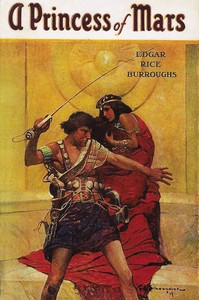
I’ve often thought that Ed McCauley, drifting through his dark, airless emergencies, might have understood John Carter’s loneliness on a dead Mars.
Both men find themselves utterly alone in a vast, silent emptiness, relying on a stubborn core of nerve. There is a particular quiet kinship in that solitude, a shared memory of human courage when the lights go out. It lingers, somehow, beside A princess of Mars — Background and Themes.

There are no reviews for this eBook.

0
0 out of 5 (0 User reviews )

Add a Review

Your Rating *
There are no comments for this eBook.

Reader reflection

What did you think of this book?

Answer a few questions and save a private reflection on this device.

Your progress 0 / 10
1

How far have you progressed with this book?

2

How did the book work for you overall?

3

Is this a title you would suggest to others?

4

How much effort did this book require?

Related eBooks