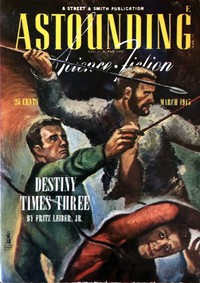
Destiny times three — Themes and Context
Edition facts
For Destiny times three — Themes and Context, the stored edition analysis reports 39,157 words, 2 hr 51 min estimated reading time, and 15 detected text sections.
The text analysis averages about 17.0 words per sentence, while the detected sections provide another way to judge how the source is divided.
Project Gutenberg metadata also associates the work with “Science fiction,” connecting these edition facts with the source record’s subject description.
Read the complete public-domain text at its original source.
Read on Project GutenbergThe novel opens with a symchromy—a color-music performance—depicting the Yggdrasil myth, a tree with roots in heaven, hell, and the land of frost giants. This ancient legend of cosmic rot and struggle is paralleled by the hypothesis Thorn and Clawly plan to present to the World Executive Committee: that multiple roots of reality exist, with worse than serpents gnawing at them. The performance leaves Thorn feeling that the faces of utopia's citizens are like masks, alien and bloodless.
Leiber immediately establishes a tension between surface harmony and underlying threat. The symchromy's closing hues, described as 'ghostly, shivering streamers of green and blue,' set a tone of visual and psychological unease. Thorn's mind becomes 'a thin, taut membrane' sensing pulses from beyond the stars, hinting at the transtime forces that will drive the plot.
The Yggdrasil Frame and Recurring Imagery
The novel's epigraph from the Elder Edda—describing the ash Yggdrasil suffering, its top bitten by a hart, its trunk rotting, and Nidhogg gnawing beneath—is not decorative. It directly informs the story's structure. The symchromy performance of the Yggdrasil myth in the opening chapter is echoed later when Thorn confronts the Servants of the People, whose gray, beggar-like tunics and puritanic grimness mirror the rot at the roots of the cosmic tree.
Leiber uses the image of roots repeatedly: 'More roots of reality than one' and 'wheels within cosmic wheels.' The Servants' chamber is described as 'notably bare' and 'gray,' with a kidney-shaped table that suggests a closed, organic system. The recurring motif of masks—Thorn seeing faces as 'masks' in the audience, and later the Servants' 'paternal aloofness'—reinforces the theme of hidden realities. The symchromy's 'last wan lightning stroke' prefigures the transtime machine's disruptive flashes.
Movement Between Scenes and Realities
The narrative shifts abruptly between settings: from the hillside symchromy to a pedestrian corridor with 'calculatingly-eyed guards,' then to a hidden niche behind a sliding door. These transitions are marked by sensory details—the 'dying upflare' of color, the 'slow speculative smile' of Clawly II—that keep the reader oriented despite the disorienting jumps.
Leiber often moves Thorn through spaces that are liminal: corridors, doorways, niches. The passage from the corridor to the Servants' room is described as a 'dim, curving passageway' ending in a 'dark niche.' This architectural ambiguity mirrors the ontological uncertainty of the plot, where characters can exchange minds across realities. The phrase 'a blind but purposeful fumbling' that seizes Thorn during the symchromy anticipates the later mind-exchanges, which are described as risky and prone to 'mental channels being blocked.'
The Servants of the People: A Study in Appearances
When Thorn first sees the Servants, he is struck by their lack of obvious malice: 'they looked in no way malignant, villainous, or evil.' But a second look reveals something worse: 'a puritanic grimness that knew no humor,' 'a suffocating consciousness of responsibility,' and 'an intolerable sense of personal importance.' Their beggarly clothes and bare room are not signs of humility but of a self-righteous austerity that Leiber portrays as more chilling than overt villainy.
The Servants' chairman is described as 'a tall thin man with wrinkle-puckered lips,' a detail that suggests age and rigidity. Their dialogue is terse and bureaucratic: 'No further exchanges should be necessary. I anticipate no emergencies.' This bureaucratic tone contrasts with the cosmic stakes of the transtime invasion they are planning. Conjerly, who has exchanged minds with one of them, speaks of 'the other body' and 'the other mind,' emphasizing the fragmentation of identity that the Servants' scheme entails.
Voice and Dialogue: Whispers and Calculated Words
Leiber's dialogue is often delivered in whispers or low tones, creating an atmosphere of conspiracy. The stranger who approaches Clawly during the symchromy converses in 'earnest, low-pitched whispers.' Later, Clawly II warns Thorn, 'No talk from here on,' and guides him past guards with the cryptic phrase 'With a person for the Servants.' These verbal economies heighten tension and suggest that language itself is a controlled resource.
When Conjerly addresses the Servants, his speech is careful and conditional: 'I must return at once. The soporific I inhaled into my other body will wear off shortly.' The phrase 'if the other mind becomes conscious, exchange will be difficult' reveals the precariousness of the mind-exchange process. The Servants' chairman responds with a curt 'You are wise,' a phrase that could be praise or dismissal. This ambiguity in dialogue mirrors the story's central uncertainty about which reality is authentic.
Readers attentive to Leiber's use of the Yggdrasil myth will find it a key to the novel's structure: the tree's multiple roots correspond to the multiple realities Thorn must navigate. The recurring images of masks, grayness, and hidden doors reward close attention. The story's movement between intimate whispers and cosmic scale—from a symchromy's 'visual silence' to a 'transtime machine'—creates a distinctive rhythm. Approach the text as a puzzle of perspectives, where every exchange of minds or glances may shift the ground beneath you.
Reading about Yggdrasil’s roots branching into parallel worlds, I remembered sitting in my grandmother’s sunroom, tracing the cracked linoleum tiles as if they were paths. That same quiet vertigo returned later with Before Egypt — Before Egypt — Reading Companion — where time folds inward like a held breath. Both books left me staring at ordinary rooms, suddenly aware of the masks we wear to keep the dread away.
There are no reviews for this eBook.
How did this book work for you?
Your answers remain private and are stored only in this browser.