The Weapon From Eternity — Reading Companion
Edition facts
For The Weapon From Eternity — Reading Companion, the stored edition analysis reports 36,744 words, 2 hr 40 min estimated reading time, and 4 detected text sections.
The text analysis averages about 10.3 words per sentence, while the detected sections provide another way to judge how the source is divided.
Project Gutenberg metadata also associates the work with “Science fiction,” connecting these edition facts with the source record’s subject description.
Read the complete public-domain text at its original source.
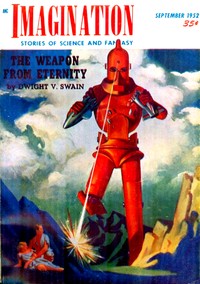
Read on Project GutenbergDwight V. Swain's The Weapon From Eternity opens with Jarl Corvett crouching in shadows on Vesta, tension crawling his spine 'like a leather-footed palau.' The prose is lean and immediate, favoring action over exposition. Swain establishes a solar system of raiders, Federation cordons, and alien species—such as the one-armed Jovian Ungo—through sharp dialogue and physical detail. The catalog subjects list 'Robots -- Fiction,' but the excerpts show no robots; instead, the focus is on human (and non-human) loyalty, desperation, and a legendary weapon that 'was its own master.' The story's pulp origins in Imagination Stories of Science and Fantasy (September 1952) are evident in its fast pacing and hard-boiled tone.
Voice and Physicality
Swain's narration is tactile and visceral. Characters are defined by physical traits and gestures: Ungo's 'scaly hand' gripping a shoulder, the Pervod's 'chill reptilian eyes,' and Jarl's 'cold and mirthless laugh.' The prose often uses short, punchy sentences to convey urgency: 'The hills fell behind. The final cordon was bypassed.' Swain also employs invented terms—'Forspark lights,' 'chang cigarette of Venus,' 'rey Gundre'—that ground the setting without lengthy explanation. Dialogue is terse and laced with insults ('you chitza!'), reinforcing the rough-and-tumble atmosphere.
Loyalty and Its Costs
The excerpts repeatedly test loyalty. Jarl reflects that 'loyalty traps you, tears you two ways,' as Ungo follows him despite the risk. The raider crew of the Knife is won over not by ideology but by Jarl's boldness and shared desire for loot and freedom. Swain presents loyalty as a double-edged sword: it drives Jarl to rescue Wassreck, but also forces him to lead friends into danger. The text does not reveal whether Wassreck is rescued or the weapon is found, but the emotional weight rests on these personal bonds.
Setting as a Character
The solar system is a patchwork of asteroid settlements, raider ports, and Federation strongholds. Vesta is a 'tiny astroidal speck'; Ceresta's port is a backdrop for tense negotiations. Swain uses setting to heighten stakes: the 'blazing lake of light' around Wassreck's workshop, the 'cindered ramping-place' where a carrier vanishes. These locations feel lived-in and dangerous, populated by 'scum of the whole wide solar system.' The Knife itself is described as 'grim, slim, deadly,' a black ship that mirrors its crew's ruthlessness. The environment is never neutral—it is always a source of threat or opportunity.
Readers should note that the excerpts cover only the opening chapters and a later scene aboard the Knife. The catalog subject 'Robots -- Fiction' does not appear in these passages; the legendary weapon is mentioned but not described. Swain's strength lies in pacing and character dynamics rather than technological speculation. Approach the text as a fast-moving adventure with a hard-boiled sensibility, where loyalty and survival are the central tensions.
There’s something about the way Jarl’s loyalty bends, but never breaks, that stayed with me long after finishing The Weapon From Eternity. It’s that quiet ache of duty against everything else. I felt a similar ghostly weight when I later came across Second Sight — Inside the Classic, almost like recognizing an old friend in a different light.
There are no reviews for this eBook.
Your personal reading reflection
Build a private reading journal entry for this title.