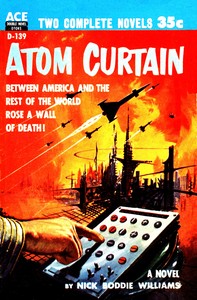
The atom curtain — Inside the Classic

(0 User reviews)   829
In Category - Social Speculation
Williams, Nick B. (Nick Boddie), 1906-1992 Project Gutenberg 2024 Not confirmed
Science fiction; Dystopias -- Fiction; United States -- Fiction Readers of public-domain and historical texts
Project Gutenberg digital edition en

Edition facts

Words 59,460
Reading time 259 min
Text sections 5

Before opening The atom curtain — Inside the Classic, the edition data offers a quick orientation: 59,460 words, 4 hr 19 min estimated reading time, and 5 detected text sections.

The text analysis averages about 16.1 words per sentence, while the detected sections provide another way to judge how the source is divided.

Project Gutenberg metadata also associates the work with “Science fiction,” connecting these edition facts with the source record’s subject description.

An editorial note on Nick B. Williams's 1956 novel, focusing on how its opening, middle, and later excerpts guide a first reading through a first-person accusation, a barrier breach, and a tense encounter in the Dome.
Share

Read the complete public-domain text at its original source.

Read on Project Gutenberg

The novel begins not with a protagonist's name or setting, but with an urgent first-person accusation: "Now at last I must make this accusation and disclose the truth." The speaker frames the risk as losing "everything that mankind has accomplished" since the first ancestor "shed his tail and rose erect." This opening, which appears to be a framing device, immediately establishes a tone of high-stakes confession and moral weight, though the excerpts do not reveal who is speaking or to whom.

The Barrier Breach and Its Framing

The book's promotional material describes Emmett O'Hara as an "air-sentinel" who breaks through the "impenetrable wall of raging atomic fury" that has isolated America for 270 years. The excerpts, however, do not depict this breach directly. Instead, the narrative opens with the accusatory voice, then shifts to O'Hara's perspective after he has already crossed the barrier. This gap between the advertised event and the textual starting point suggests that the novel may use the breach as a premise rather than a set piece. Readers should note that the opening accusation may belong to O'Hara or another character, and its relation to the barrier remains unclear from the excerpts alone.

The Dome and the Father's Welcome

In a later excerpt, O'Hara and a woman named Nedra are brought before a figure called "the Father" in a hall named the Dome. The Father's dialogue is formal and theatrical: "I welcome you, O'Hara. You and the woman from the mountains, welcome." He describes the Dome as designed to be impressive, "as if a visitor were standing at the core of the earth." The room's architecture—arched ceiling, stone walls, and a vaulted glasslike ceiling—is described in detail. The Father's hospitality is undercut by a "last precaution": a panel clangs down, trapping O'Hara and Nedra in an exquisite but windowless room. This sequence establishes a pattern of controlled revelation and confinement.

Nedra's Despair and O'Hara's Curiosity

Trapped in the hexagonal room, Nedra accuses O'Hara of weakness: "you refused, you were too weak, you will be the father of my child." She insists on the "privilege of death," while O'Hara counters with a desire to "learn to endure." Their argument reveals a central tension: Nedra's obsession with dying versus O'Hara's "thirst to know what happens next." O'Hara claims to have "the means" of death in his jacket, yet hesitates. The room fills with strange music—"the music of sirens, the music of desire"—as the light fades. This scene, rich in sensory detail and philosophical conflict, suggests that the novel's core may be the struggle between survival and surrender.

Voice and Structure Across the Excerpts

The excerpts shift between a first-person accusatory prologue and a third-person narrative focused on O'Hara. The prologue's language is biblical in cadence ("we condemn our world… forever to our chronic agonies"), while the later sections employ more direct dialogue and descriptive prose. The author's afterword mentions the novel was conceived as an adventure story with "philosophical ideas" mixed in, and the excerpts bear this out: the opening promises a world-altering accusation, but the body dwells on intimate confrontation. Readers should watch for how the accusatory voice returns, if at all, and whether the philosophical debates between O'Hara and Nedra drive the plot.

The excerpts present a novel that oscillates between grand geopolitical premise and claustrophobic personal drama. The barrier that isolates America is less a setting than a given; the real action unfolds in the Dome's trapped spaces and the arguments between O'Hara and Nedra. First-time readers may find it useful to track the relationship between the opening accusation and the later events, and to note how the Father's controlled environment mirrors the larger isolation of the continent.

That moment in The Atom Curtain, where the barrier splits and everything slows—it stayed with me for days. It felt less like science fiction and more like remembering something true about boundaries. I found a similar quiet ache flipping through The Age of Science: A Newspaper of the Twentieth Century — Key Ideas to Explore, where each page feels like a hinge between decades. We carry these fragmented histories longer than we expect.

There are no reviews for this eBook.

0
0 out of 5 (0 User reviews )

Add a Review

Your Rating *
There are no comments for this eBook.

Reader reflection

How did this book work for you?

Your answers remain private and are stored only in this browser.

Your progress 0 / 10
1

Have you finished this book?

2

What was your overall reaction to the book?

3

Is this a title you would suggest to others?

4

What was the reading difficulty like?

Related eBooks