
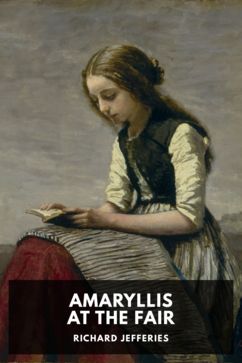
Amaryllis at the Fair - Richard Jefferies
If you're looking for a plot with car chases and shocking twists, you might need to look elsewhere. But if you want a story that feels as real as the soil in a garden and just as complex, you've found it. 'Amaryllis at the Fair' is a slow, beautiful, and often painful look at a family on the brink.
The Story
We settle into Coombe Oaks, the farm of the Iden family. It's not a thriving business; it's a place slowly being reclaimed by debt and neglect. Iden, the father, is a fascinating contradiction. He's a man of immense knowledge about nature and literature, but he's utterly hopeless when it comes to the practicalities of running a farm or managing money. He'd rather spend his day observing a single blade of grass than balancing the books. His wife is exhausted, trying to hold things together with dwindling resources. At the center is their daughter, Amaryllis. She's young, sharp, and full of a restless energy that has nowhere to go. She sees the cracks in their life with painful clarity. The annual fair comes to their local town, bringing a burst of noise, color, and temporary escape. For Amaryllis, it represents a world beyond her stifling home, a glimpse of possibility. The story follows her as she navigates this tension between family duty and personal desire, watching her home deteriorate while wondering if there's a future for her outside of it.
Why You Should Read It
This book got under my skin. Jefferies writes about the English countryside with a love so deep it feels like another character. You can smell the damp earth and hear the rustle of the trees. But he doesn't romanticize rural poverty. The real magic is in the characters. Iden is frustrating, yes, but also strangely noble in his refusal to be ruled by money. Amaryllis is a heroine for the ages—not because she slays dragons, but because she endures. Her quiet strength and intelligence in the face of a slow-motion disaster are incredibly moving. The book asks hard questions about failure, family obligation, and what it means to waste a life, or to save one. It's melancholic, but not hopeless. There's a stubborn beauty in the way life, like the amaryllis flower, insists on blooming even in poor soil.
Final Verdict
This is a book for patient readers and lovers of deep character studies. It's perfect for anyone who enjoys the rich, detailed worlds of Thomas Hardy or George Eliot, but with a quieter, more domestic focus. If you've ever felt stuck, ever watched a loved one make bad decisions, or ever found beauty in a struggling place, this story will resonate with you. Don't rush it. Let it unfold like a long summer afternoon, and you'll be rewarded with a portrait of family life that is heartbreaking, honest, and unforgettable.
This work has been identified as being free of known copyright restrictions. It is available for public use and education.
Margaret Taylor
6 months agoGreat value and very well written.
Nancy Martinez
11 months agoExceptional clarity on a very complex subject.
George Gonzalez
1 year agoThe information is current and very relevant to today's needs.
Andrew White
2 years agoAmazing book.









Donald Lopez
7 months agoThe analytical framework presented is both innovative and robust.